Construction daily log: what to record every day
A construction daily log is the running record of everything that happens on site — labor, weather, work progress, deliveries, delays and visitors — kept every working day. It differs from a daily report in audience: the log is your internal record; the report is the version you distribute.
The 9 entries of a complete daily log
| Entry | Why it matters |
|---|---|
| 1. Workforce — headcount per trade and contractor | Settles payment and productivity disputes |
| 2. Weather — conditions and their effect | Foundation of weather delay claims |
| 3. Work completed — by area, with quantities | Progress evidence against the program |
| 4. Equipment — on site, working or idle | Idle plant is money; prove why |
| 5. Deliveries — what arrived, complete or short | Ties supplier failures to delays |
| 6. Delays and disruptions | Contemporaneous record for claims |
| 7. Visitors and inspections | Proves who saw what, and when |
| 8. Safety events — briefings, incidents, near misses | Compliance and defense in investigations |
| 9. Photos — timestamped, located | Turns every entry above into evidence |
Paper log, spreadsheet or app?
A paper log book meets most contract requirements — until it gets wet, stays in the cabin when you need it in a meeting, or a page goes missing right where the dispute sits. Spreadsheets centralize the record but push the actual writing to the office, hours after the fact, with photos living somewhere else entirely.
The reason field apps won this argument is simple: the log is only as good as what gets captured in the moment. A phone is on site, in a pocket, with a camera and a clock. The log that takes the least effort to keep is the log that actually gets kept. See our guide to going paperless on site for the migration path.
Make it a habit the crew keeps
- Same time, same trigger. Tie log entries to fixed moments: headcount at the morning brief, photos at the midday walk, delays as they happen.
- Make one person accountable per day — but let everyone contribute. The foreman owns the log; the crew feeds it photos and notes.
- Review weekly. A five-minute Friday scan catches gaps while the week is still fresh enough to fix them honestly.
Doing this in TerenIQ
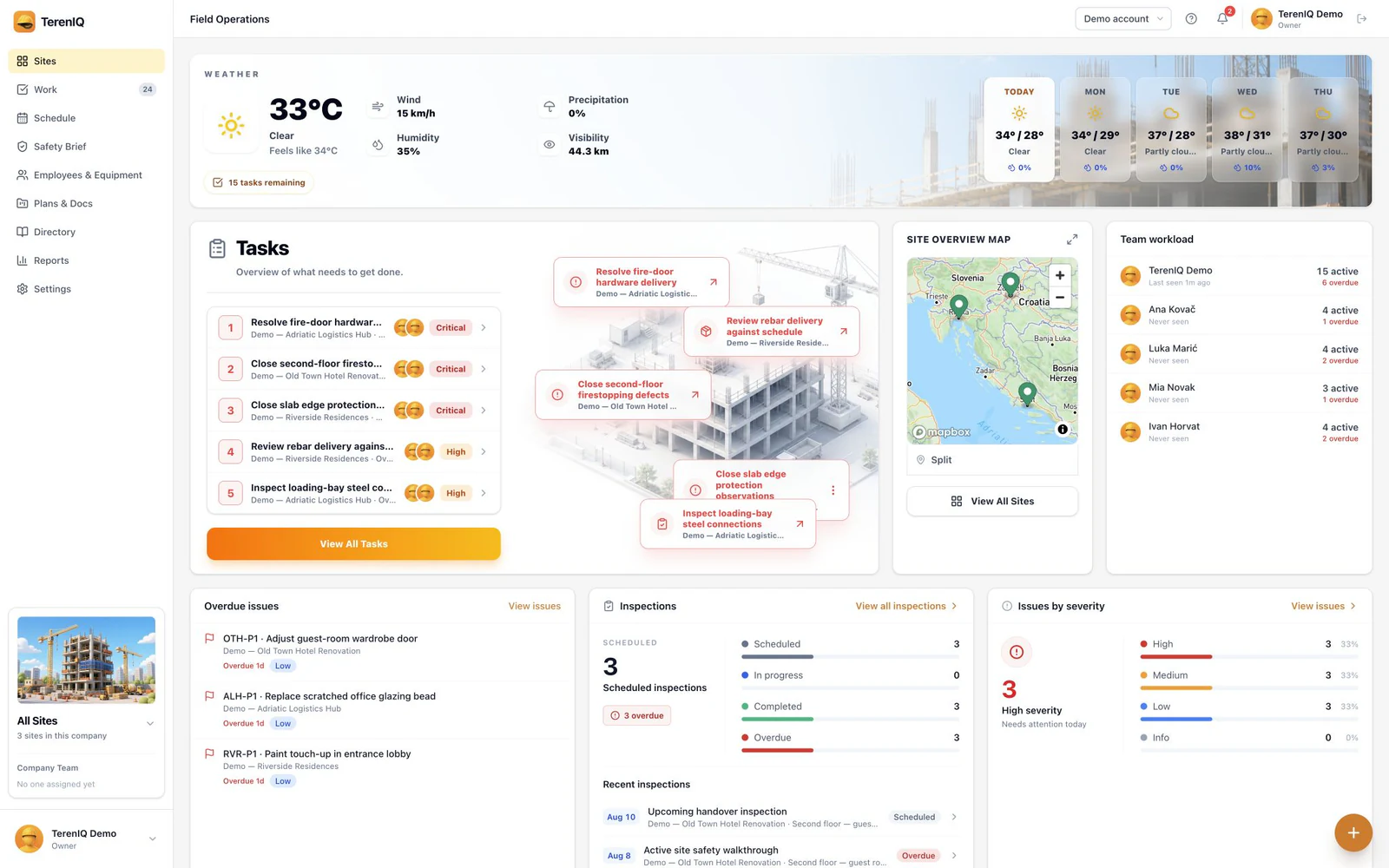
In TerenIQ the daily log builds itself from the day's activity instead of being a separate chore:
- Tasks closed, inspections run, photos taken and safety briefs acknowledged during the day are already in the project record — the log entry is a review, not a rewrite.
- Weather is logged automatically from live site conditions.
- Entries keep their author and time. Precise GPS is added only when a user chooses a location-enabled feature, so the log also supports an audit trail.
- Need the distributable version? The daily report compiles from the same data with one tap.
Frequently asked questions
What is the difference between a daily log and a daily report?
The daily log is the complete internal record of the day; the daily report is the formatted summary you send to clients or head office. Keep one log and generate the report from it — never maintain two records by hand.
How long should daily logs be kept?
At least as long as your contract's limitation period — commonly 6 to 12 years depending on jurisdiction. Digital logs make long retention effectively free.
Can subcontractors keep their own log in the same system?
In TerenIQ, yes — the directory tracks which subcontractor each person belongs to, and role-based access controls what each company sees.