What is an RFI in construction?
An RFI (request for information) is the formal written question a contractor raises when drawings, specifications or site conditions leave something unclear — and the documented answer that becomes part of the project record. It exists so that clarifications are decisions on paper, not conversations someone half-remembers.
When to raise an RFI
- Conflicting information: the structural drawing says one thing, the architectural another.
- Missing information: a detail, dimension or specification simply is not there.
- Site conditions vs design: what was found on site does not match what was assumed — ground conditions, existing services, survey errors.
- Constructability: the detail as drawn cannot practically be built, and you need the designer's direction before proposing an alternative.
- Material substitutions: the specified product is unavailable and a substitute needs approval.
The test: if proceeding on your own interpretation could cost money or time if you guessed wrong, raise the RFI. A ten-minute question beats a €40,000 rework argument.
The RFI lifecycle
- Raised by the contractor or subcontractor, numbered, with the question, references and photos.
- Routed to the party who can answer — architect, engineer, or client — usually via the main contractor.
- Answered in writing, within the contractual response window (commonly 5–10 working days; check your contract).
- Actioned — the answer reaches the crew doing the work, which is the step most systems fumble.
- Archived — question and answer stay in the record; if the answer changed cost or time, it feeds the change process.
Two metrics tell you whether RFIs are healthy on a project: average response time, and how many RFIs are open against activities that start in the next two weeks. The second one is where delays are born.
Why RFIs stall — and what fixes it
RFIs stall in transit: buried in inboxes, forwarded without their attachments, answered in a phone call that never gets written down. The fix is structural, not motivational — one shared queue where every open RFI is visible with its age, and where the answer lands next to the question, notifying the person who asked. When the foreman can read the answer on the deck instead of driving to the office, the RFI loop stops being a schedule risk. See how to write an RFI that gets answered fast.
Doing this in TerenIQ
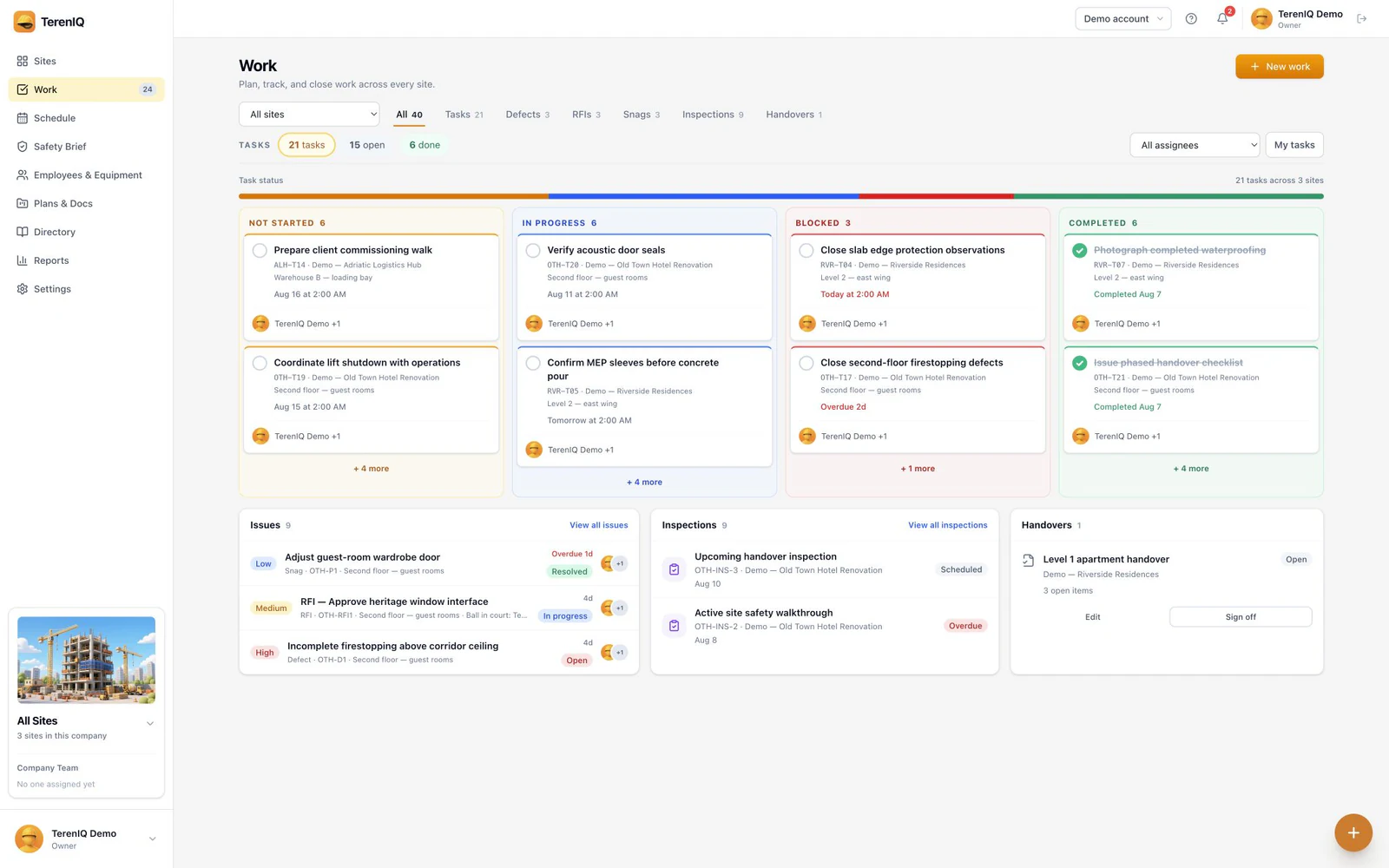
TerenIQ treats RFIs as live work items, not email threads:
- Raise an RFI from the phone with photos and a pin on the drawing — the context travels with the question.
- The office answers from the web app; the foreman reads it on the deck the moment it lands, via push notification.
- Every RFI keeps its full history — who asked, who answered, when — in the project record.
- Open RFIs sit in the same work queue as tasks and defects, so nothing ages invisibly.
Frequently asked questions
What does RFI stand for in construction?
Request for information — a formal written question raised to clarify drawings, specifications or site conditions, answered in writing and kept in the project record.
How long should an RFI response take?
Contracts commonly allow 5–10 working days. On live sites, every day an RFI blocks a critical activity is schedule risk — which is why response time is worth tracking per project.
Is an RFI a change order?
No. An RFI asks a question; if the answer changes scope, cost or time, it triggers the change process as a separate step. Keeping the RFI record clean is what makes that link auditable.