Daily safety briefing: format, topics and records
A daily safety briefing (pre-start, pre-task or morning huddle) aligns the crew on today's work, today's hazards and today's coordination points before tools come out. Ten minutes at the gate, and the difference between crews that improvise and crews that execute.
The 10-minute format
- Today's work (2 min). What each gang does, where. This is where clashes surface — two trades in one riser, deliveries against a crane lift.
- Today's hazards (4 min). Not generic: the specific conditions of today. Weather and its consequences, live edges, energized systems, plant movements, anything that changed overnight.
- Coordination points (2 min). Permits active today (see permits to work), exclusion zones, who controls the shared resources.
- Questions and confirmations (2 min). Ask the crew what is missing. Then confirm everyone acknowledged the brief — individually.
Briefing vs toolbox talk
They are cousins, not twins. The daily briefing coordinates today's plan and runs every day; the toolbox talk teaches one safety topic in more depth, typically weekly or when the work changes. Sites that merge them into one long morning meeting usually end up doing neither well — coordination gets rushed and the topic becomes a formality. Keep the daily brief tight and let toolbox talks go deep.
The acknowledgement record
The brief only counts if you can prove who received it. The standard that satisfies auditors and investigators:
- Per worker — each person acknowledges individually, not one signature “on behalf of the gang.”
- Timestamped — acknowledgements logged before work started, not reconstructed at lunch.
- Tamper-evident — a record that cannot be quietly extended after an incident is a record worth having.
- Retrievable — by worker, by date, by topic, in seconds, from wherever the question is asked.
Doing this in TerenIQ
This is a core TerenIQ workflow:
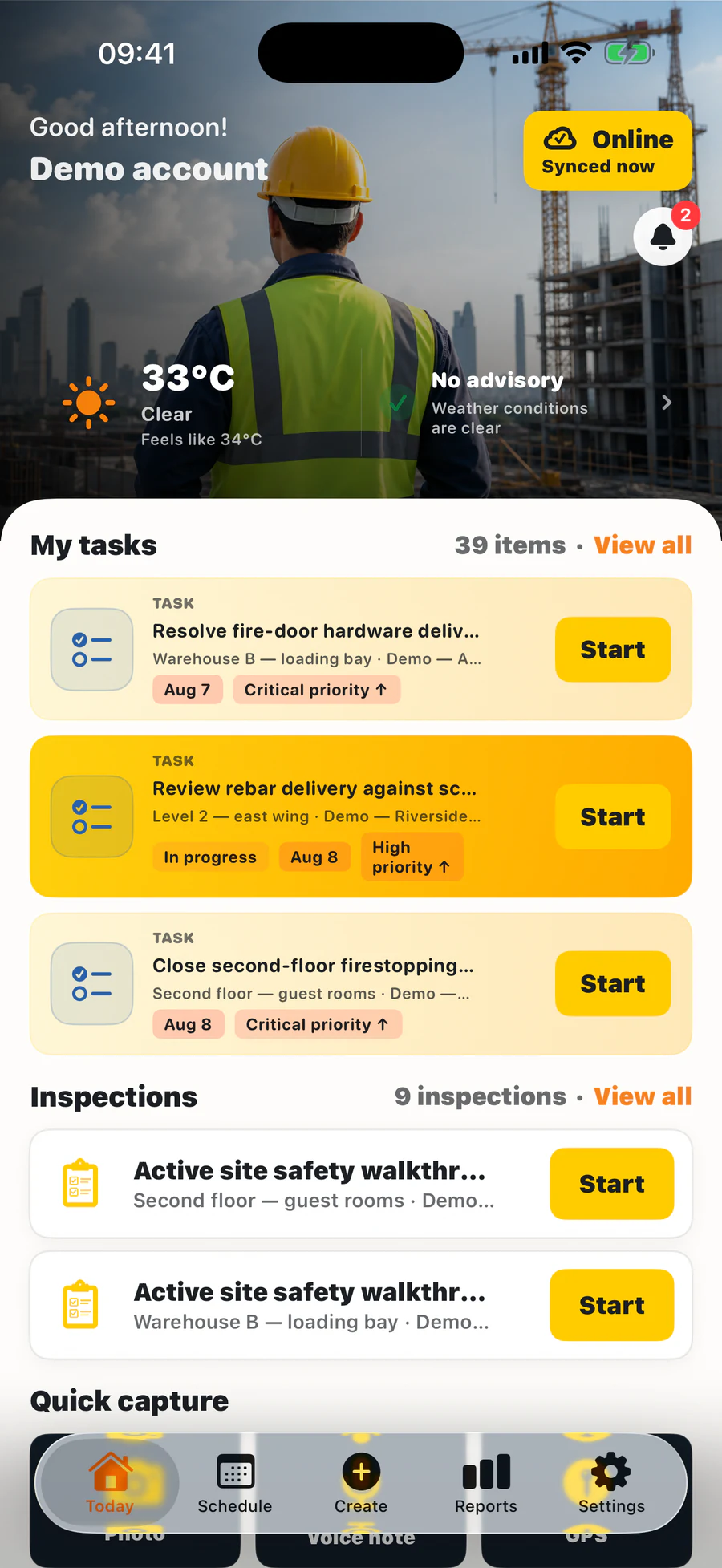
- The morning safety brief goes out in the app and every worker taps to acknowledge at the gate — names and times land in the log automatically.
- Supervisors see missing acknowledgements before work starts.
- Live weather and site advisories feed the “today's hazards” section — wind against a lift plan flags itself.
- The acknowledgement history is preserved with a full audit trail, exportable whenever compliance asks.
Frequently asked questions
How long should a daily safety briefing take?
Ten minutes is the sweet spot — long enough to cover work, hazards and coordination, short enough that it happens every single day without resistance.
Does every worker need to attend the daily briefing?
Everyone working that day should receive and acknowledge it — including late arrivals, who should be briefed individually before starting. Digital acknowledgement makes the late-arrival gap visible.
What records should be kept of daily briefings?
Date, content covered, deliverer, and per-worker acknowledgement with times. Keep them for the project duration at minimum — they are primary evidence in any incident investigation.